

EV Charger Wallbox: Form Factors and How They Compare
The term "EV charger wallbox" describes a fixed AC charging point, but "wallbox" already hints at its defining trait — it is built to mount on a wall. That mounting choice sits inside a wider set of form decisions: wall, pedestal or portable; tethered cable or socket. This guide focuses on the form dimension, because the right shape often matters as much as the power rating when a site is actually built out.
What an EV Charger Wallbox Is
At its core it is a compact AC enclosure that fixed-mounts to a structure and delivers protected current to a vehicle through a standard connector. Unlike a portable unit it has a permanent supply and permanent home; unlike a pedestal it borrows its support from an existing wall or post. Gresgying's wallbox overview sets out the family, and the Turbo Wallbox is the unit these form comparisons refer to.
Form Factors Compared: Wall-Mounted, Pedestal and Portable
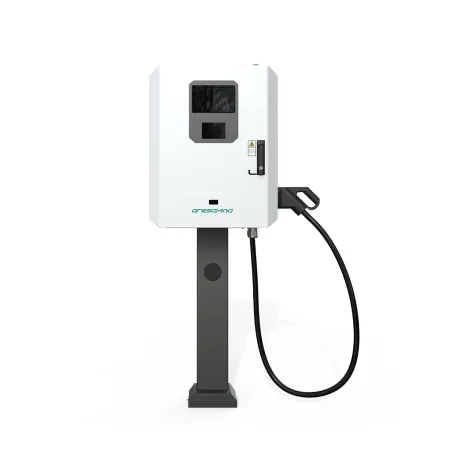
A wall-mounted box saves floor space and is cheapest to install where a suitable wall exists. A pedestal — a wallbox on a freestanding post — serves open car parks with no adjacent wall. A portable charger plugs into a socket and travels with the driver but offers no fixed metering, access control or cable management. The trade is permanence versus flexibility: the more a point is shared or billed, the more a fixed wall or pedestal form wins. A workplace charging layout almost always favours a fixed form for exactly this reason.
Tethered Cable versus Socket Outlet
A tethered unit carries its cable on the body, so the driver just unplugs and connects — convenient and weather-protected. A socket-outlet version leaves the cable in the car, which some drivers prefer but exposes the connector to loss and weather. For shared or outdoor sites, tethered is usually the safer everyday choice; for a private garage where the cable lives inside, a socket can be tidier. The charging-point guide discusses how access and cable choices affect shared locations, and the home charger guide covers the private-garage case.
Why the Wall-Mounted Form Dominates
Most charging happens where a wall already exists — a garage, a building facade, the side of a retail unit. Mounting to it removes the cost of a foundation and a post, and keeps the unit at a comfortable height for cable handling. That is why the wall-mounted form is the default across residential and commercial installs alike, and why Gresgying's AC product line leans on it for the bulk of deployments. The smart AC charger overview reinforces the same point from the capability side.
Ironically, the wall-mounted form also ages better. A post sunk into tarmac can be undermined by ground movement or damaged by a vehicle; a wall unit rides on a structure that is already engineered to last. For multi-site operators this lowers the replacement cycle and keeps spare parts simple. The pattern repeats across Gresgying's AC range, where wall-mounted units are the default SKU and pedestals are treated as an accessory rather than a separate product family.
Enclosure Ratings for Indoor and Outdoor Use
Outdoor units need a genuine IP54 or better rating so rain, dust and light impact do not reach the electronics, plus a temperature range that covers the local climate. Indoor units can use lower ratings but still benefit from the same protection. Enclosure choice is not optional for exterior mounting — the commercial wallbox safety standard spells out what outdoor certification should cover before a unit goes outside.
When a Pedestal Solves a Problem a Wallbox Cannot
Open lots, island bays and pull-through spaces have no wall to mount on, and running supply to a distant facade is often more expensive than a pedestal. A pedestal brings the point to the vehicle. Retail and destination sites use this routinely, as the retail destination solution shows, placing points where customers actually park rather than where the building happens to be.
Cable Management and Everyday Durability
The most common wallbox failure is not electronics but cable — a connector left on the ground, a cable run over by a tyre, a holster that does not retain. Good wall units integrate a holster and a hook, or a tethered cable with a proper dock, which protects the most fragile part. The rise of EV-ready parking lots is pushing this from nice-to-have to expected, and residential guidance covers the same basics for a home bay.
Durability is also a procurement question. A unit with a well-designed holster and a cable of the right length spends less time being dragged across gravel or dropped in a puddle, and that shows up in warranty claims. Site owners who specify tethered wallboxes with integrated docking tend to report fewer connector failures than those using loose sockets and driver-carried cables. The point is unglamorous but real: the cheapest failure to prevent is the one you design out at the wall, because a wallbox that survives its cable outlasts every competitor on the spec sheet.
Conclusion
Form is a real decision, not a footnote. Wall-mounted boxes dominate for good reason — low cost, simple install, proven durability — while pedestals earn their place where no wall exists and tethered cables protect the connector day to day. Match the shape to the bay, confirm the enclosure rating, and the hardware will outlast the vehicle it serves. The installation guide fills in the practical steps once the form is settled.
Choosing the Right Wallbox Form?
Talk to Gresgying about wall-mounted versus pedestal, tethered versus socket, and the enclosure rating your site needs.
Get Your Free Quote →Related Products
More items about wallbox charger


We Have The Best Solutions for Your Business
User Reviews
What users say about Us
Frequently Asked Question
Do you have any question?
Our Wallbox Chargers have a power output range from 3.7 kW to 22 kW.
Yes, our Wallbox Chargers are designed to be compatible with all types of EVs.
Yes, we provide a 2-year warranty on all our Wallbox Chargers.
The charging time depends on the EV's battery capacity and the charger's power output. On average, it takes about 4-6 hours.
Yes, our Wallbox Chargers are designed for both indoor and outdoor installations.
Yes, our Wallbox Chargers are certified by TÜV, CE, and other relevant safety standards.
Yes, our Wallbox Chargers can be integrated with most smart home systems.
Yes, our Wallbox Chargers are designed to handle voltage fluctuations.
Our updates and blog posts

Gresgying AC Charger: Powering Your Devices Efficiently
Gresgying AC Charger is an efficient, safe and portable charger that provides fast and safe charging for a variety of devices, making it your ideal charging solution.
Gresgying Charging Center: Revolutionizing the way we power our devices
Gresgying Charging Hub is a powerful and portable charging station that can provide fast and safe charging for multiple devices at the same time, making it an ideal choice for technology enthusiasts.
Gresgying charging stations: the rules of the road for device charging
Gresgying Charging Station is a powerful and portable charging station that can provide fast and safe charging for multiple devices at the same time, making it an ideal choice for technology enthusiasts.